咨询热线:18906399575

Glass furnaces operate under sustained high-temperature conditions. The main crown and regenerator crown are important areas to consider when planning refractory maintenance and insulation work.
The performance of an insulation system depends not only on material selection but also on the coordination of individual layers, structural interfaces, and construction quality.
At a glass furnace project in Peru involving Xinxiang Tianyi Refractory Materials Co., Ltd., multilayer insulation work on the main crown and regenerator crown is progressing according to the construction plan. The silica refractory plastic layer and high-temperature material layer have been completed, while installation of the intermediate-temperature layer continues.
Current construction progress:
First layer: 30 mm silica refractory plastic — completed.
Second layer: 100 mm high-temperature material — completed.
Third layer: 100 mm intermediate-temperature material — approximately 50% completed.
The project is progressing from the initial refractory layer toward the completion of the multilayer insulation structure. As work continues, attention remains on material coverage, specified thickness, continuity, and the interfaces between completed and unfinished areas.
The main crown of a glass furnace operates under demanding thermal conditions. Its insulation system must be designed according to the structure and the actual service requirements.
Simply increasing the thickness of one material does not necessarily guarantee the performance of the complete system. Different materials have different temperature capabilities, thermal conductivity characteristics, expansion behavior, and installation requirements.
A multilayer system should therefore be designed so that each material performs its intended function while maintaining appropriate interfaces with adjacent layers.
Important considerations include:
Material compatibility: Each layer should suit its intended location and be consistent with the overall design.
Structural continuity: Avoid uncovered areas, unintended gaps, and discontinuities in the insulation system.
Thickness control: Install each layer according to the project drawings and technical requirements.
Construction access: Consider the curved surfaces, edges, and transitions of the furnace crown when planning installation.
The first layer of 30 mm silica refractory plastic has been completed.
The precise function of silica refractory plastic depends on its formulation, specified application, and the design of the furnace structure. In glass furnace projects, installation quality is closely related to substrate conditions, uniform application, and compliance with the specified construction method.
After this stage, the installed surface should be inspected for visible defects and continuity. The next layer should proceed in accordance with the project requirements and the relevant technical instructions.
On curved structures such as furnace crowns and regenerator crowns, particular attention should be given to edges, connection areas, and irregular sections where installation access may be limited.
The second layer, with a specified thickness of 100 mm, has been completed.
The selection of high-temperature materials should reflect the operating conditions of the intended area and the engineering requirements of the project.
After installation, inspection should cover more than the material type and nominal thickness. The continuity of coverage and the condition of the completed surface should also be reviewed.
Key inspection points include:
Continuous coverage of the completed area.
Thickness consistent with the design requirements.
Proper treatment of edges, corners, and structural transitions.
Protection of completed sections during subsequent work.
Appropriate construction records and photographs.
Stage-by-stage inspection helps identify visible defects before they are covered by subsequent layers and can reduce the risk of unnecessary rework.
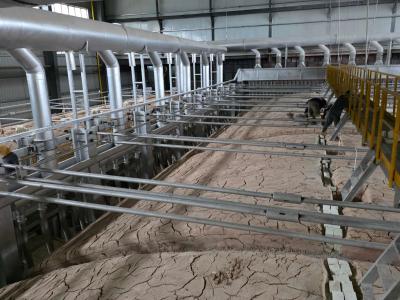
Approximately half of the third layer, specified at 100 mm, has been completed, and installation is continuing.
As this layer progresses, the construction team should maintain continuity between work sections and carefully coordinate completed areas with those still under installation.
At crown edges, connections around the regenerator crown, and changes in structural geometry, the installation thickness and material distribution should follow the approved design. Localized gaps, uneven thickness, and insufficient joint treatment should be avoided.
Construction sequence and inspection are equally important in a multilayer insulation system. Each completed section should be checked and documented before the work advances.
Actual installation procedures must follow the project drawings, product technical documentation, and site instructions. The specific function or suitability of a material should not be inferred from its name alone.
Glass furnace maintenance often involves several coordinated construction stages. Reliable records help project stakeholders track progress and verify material use and workmanship.
Useful records include:
Material names, specified thicknesses, and completion status for each layer.
Construction progress in different areas of the main crown and regenerator crown.
Treatment of edges, joints, and structural transitions.
Photographs taken after each major stage.
Issues identified during construction and the corresponding corrective actions.
Final acceptance should be based on the project specifications and actual site conditions. Layer count and thickness are important, but continuity, structural compatibility, and installation quality also need to be considered.
Glass furnace insulation projects require coordination between refractory materials, insulation materials, and on-site construction management. The appropriate material combination and construction method should be determined according to operating conditions, structural design, and project requirements.
Xinxiang Tianyi Refractory Materials Co., Ltd. specializes in refractory and insulation materials, including refractory plastic, refractory castables, refractory bricks, and related high-temperature insulation products. Material selection and technical discussions can be arranged according to specific project needs.
Multilayer insulation work on the main crown and regenerator crown of the glass furnace project in Peru is continuing. Through project documentation, we aim to share practical insights into material applications, construction progress, and quality management for glass furnace insulation projects.
If your glass furnace is preparing for maintenance, refractory replacement, or an insulation upgrade, please contact us to discuss your project requirements and suitable material solutions.