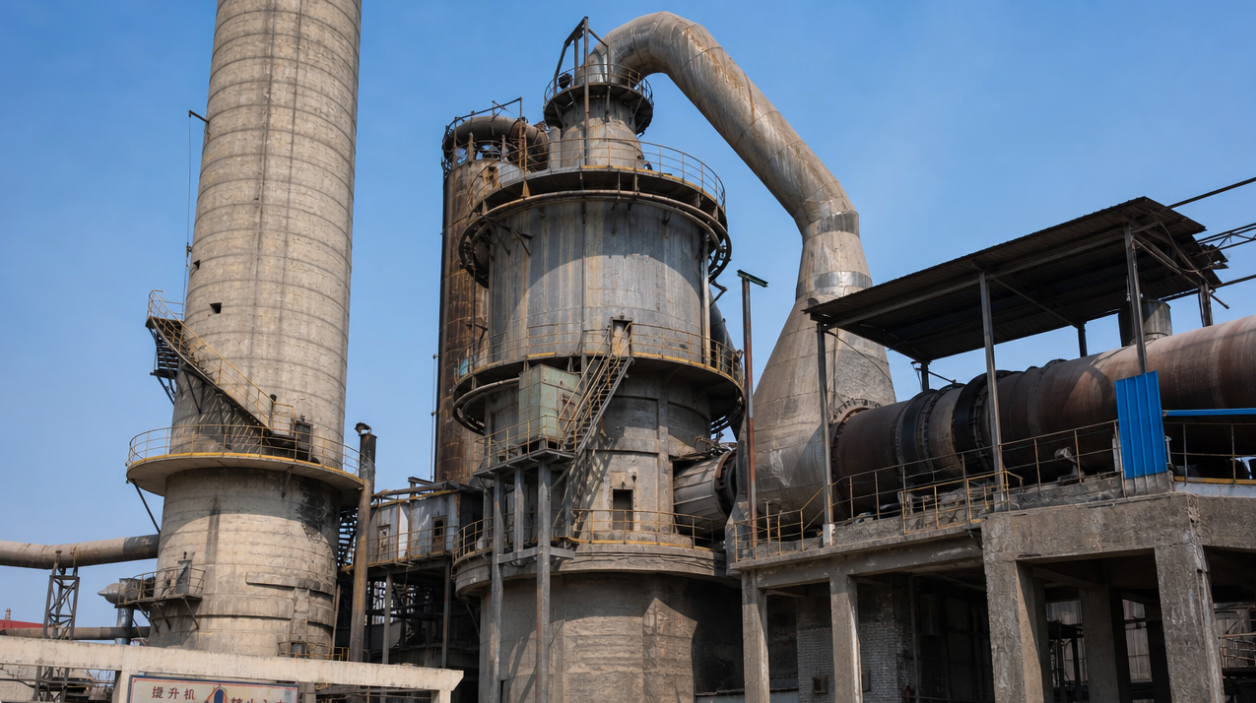
A lime kiln is an industrial furnace used to produce quicklime by calcining limestone at high temperatures. It is widely used in metallurgy, building materials, chemical processing, environmental protection, and other industries. Depending on the kiln structure, production method, and combustion process, lime kilns can be divided into several types. Different kiln designs vary in production capacity, thermal efficiency, automation level, and lime quality.
1. Main Types of Lime Kilns and Their Characteristics
1. Shaft Kiln
A shaft kiln generally has a vertical cylindrical structure. Limestone is charged from the top and gradually moves downward, where it undergoes preheating, calcination, and cooling through heat exchange with hot gases.
Advantages: Relatively simple structure, small footprint, comparatively low investment and maintenance costs, and good sealing performance.
Disadvantages: Limited production capacity for a single kiln and relatively high requirements for limestone size and process control.
Applications: Suitable for small- and medium-scale lime production projects, with typical capacities of approximately 50–500 tons per day.
2. Rotary Kiln
A rotary kiln mainly consists of a horizontal or slightly inclined steel cylinder. Continuous rotation causes the limestone to move and mix inside the kiln, allowing it to fully contact the hot gases during calcination.
Advantages: High production capacity, continuous operation, good adaptability to different raw material sizes, and a high level of automation.
Disadvantages: More complex equipment, larger footprint, higher investment costs, and generally higher heat consumption than some advanced vertical kiln systems.
Applications: Widely used in large-scale lime production lines as well as steel, chemical, and other industries, with typical capacities of approximately 300–1,500 tons per day.
3. Annular Shaft Kiln
An annular shaft kiln uses a special internal sleeve structure to organize gas flow efficiently, allowing limestone to pass through the preheating, calcination, and cooling zones.
Advantages: High thermal efficiency, relatively low fuel consumption, stable calcination, and effective heat recovery.
Disadvantages: More complex equipment and process control, higher initial investment, and greater requirements for operation and maintenance.
Applications: Suitable for large lime production plants and projects requiring high product quality and low energy consumption.
4. Double-Chamber Kiln
A double-chamber kiln consists of two interconnected kiln chambers. The two chambers alternately perform calcination and heat-storage functions, allowing efficient utilization of the heat contained in the hot gases.
Advantages: High thermal efficiency, good fuel utilization, stable calcination, continuous operation, and suitability for producing highly reactive lime.
Disadvantages: Relatively complex equipment and auxiliary systems, resulting in higher construction costs.
Applications: Mainly used in medium- and large-scale lime production lines, especially where high lime reactivity and consistent product quality are required.
5. Other Special Kiln Types
Maerz Lime Kiln: Uses a parallel-flow regenerative double-chamber design. Through efficient combustion and heat circulation, it improves energy utilization and can produce lime with high and stable reactivity.
2. Classification by Production Method
1. Batch-Operation Kilns
Batch kilns operate according to individual production cycles, including charging, calcination, and discharge.
Characteristics: Relatively simple equipment and flexible operation.
Disadvantages: Limited continuous production capacity and generally higher fuel consumption per unit of product.
Typical Types: Traditional shaft kilns and some intermittent reverberatory-type kilns.
2. Continuous-Operation Kilns
Continuous lime kilns can continuously perform charging, preheating, calcination, cooling, and discharge.
Characteristics: High production efficiency, relatively stable product quality, suitability for large-scale continuous production, and easy automation.
Disadvantages: More complex equipment and control systems, with relatively high construction and maintenance costs.
Typical Types: Rotary kilns, mechanized shaft kilns, double-chamber kilns, and annular shaft kilns.
3. Comparison of Different Lime Kiln Types
| Comparison | Shaft Kiln | Rotary Kiln | Double-Chamber Kiln | Annular Shaft Kiln |
| Capacity | 50–500 t/day | 300–1,500 t/day | 120–800 t/day | Medium to large scale |
| Thermal Efficiency | Medium | Relatively high | High | High |
| Investment Cost | Low | High | Relatively high | Relatively high |
| Footprint | Small | Large | Medium | Medium |
| Automation | Medium | High | High | High |
| Suitable Fuels | Various | Various | Various | Various |
| Lime Quality | Fair to good | Good | Excellent | Excellent |
4. Lime Kiln Selection Recommendations
When selecting a lime kiln, companies should consider production capacity, limestone characteristics, fuel availability, required lime quality, energy consumption, environmental requirements, and other operating conditions.
Small-scale projects: Shaft kilns or mechanized shaft kilns can be considered because of their relatively low investment and small footprint.
Medium-scale projects: Annular shaft kilns or medium-sized double-chamber kilns can be selected according to product quality and energy-saving requirements, balancing production capacity, energy consumption, and investment.
Large-scale projects: Large rotary kilns, double-chamber kilns, or annular shaft kilns are generally suitable for continuous and large-scale production.
Projects with high energy-efficiency and environmental requirements: Priority should be given to kiln systems with high fuel utilization, effective waste-heat recovery, and efficient flue-gas treatment systems.
Fine-grained limestone: Rotary kilns generally have good adaptability to relatively small limestone sizes, although the final selection should be based on the specific raw material and production process.
Overall, different lime kiln types have their own advantages and limitations. Companies should select the most suitable kiln according to production scale, raw material characteristics, fuel type, product quality requirements, and environmental standards. In addition, refractory bricks, refractory castables, and thermal insulation materials used in the kiln lining can have a significant impact on equipment service life, energy consumption, and production stability.