Why Are Industrial Furnaces Consuming More Energy? The Hidden Reason May Be Refractory Insulation Failure
In high-temperature industries such as steel, glass, cement, chemical processing, and metallurgy, energy consumption has always been one of the biggest operating costs.
Many industrial plants experience the same problems:
Fuel consumption keeps increasing
Furnace shell temperature becomes higher
Production output remains unchanged while energy costs rise
Furnace maintenance frequency increases
In many cases, the problem is not the burner system or production process. The real issue may be hidden inside the refractory and insulation system.
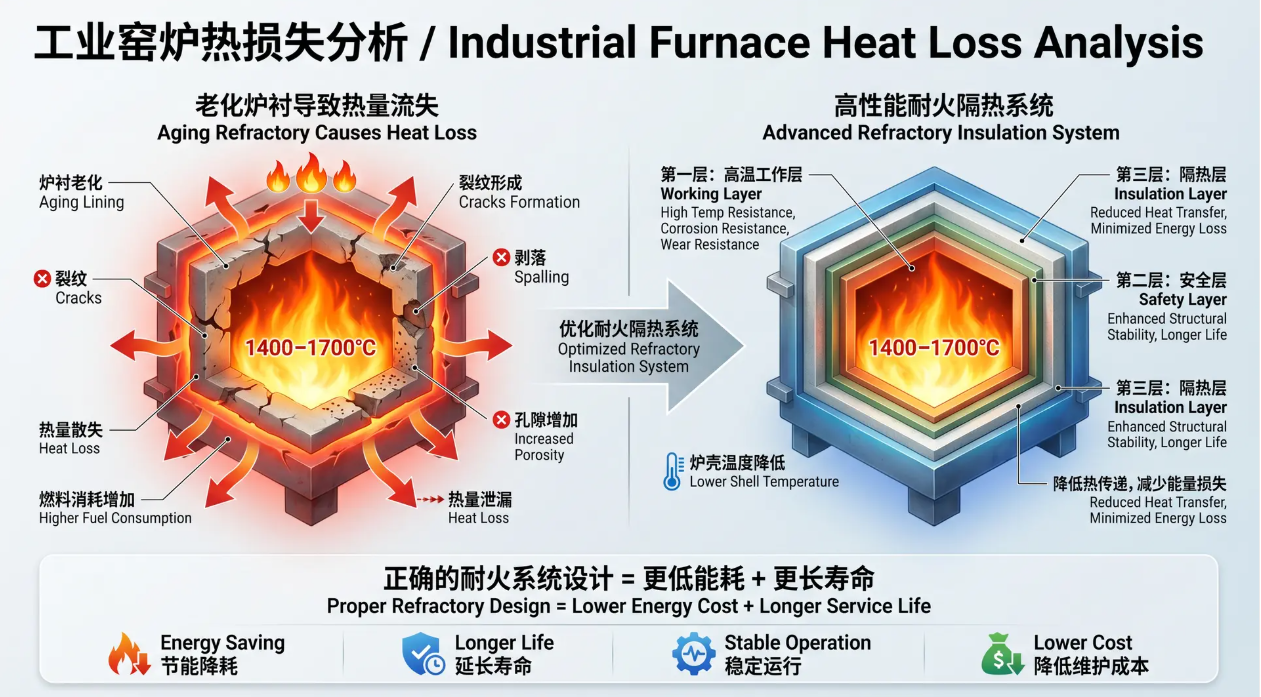
1. Aging Furnace Linings Cause Significant Heat Loss
Industrial furnace linings are exposed to extreme conditions for long periods, including:
High temperatures
Thermal cycling
Chemical corrosion
Mechanical wear
Over time, the internal structure of refractory materials gradually deteriorates.
Common changes include:
As the lining performance decreases, heat that should remain inside the furnace escapes through the furnace wall.
The results are:
Higher fuel consumption
Increased furnace shell temperature
Rising production costs
2. Low Thermal Conductivity Refractory Materials Improve Energy Efficiency
Traditional refractory selection often focuses on:
However, modern industrial furnaces require more than temperature resistance.
Energy efficiency has become a key factor.
Low thermal conductivity refractory and insulation materials help reduce heat transfer and minimize energy loss.
Common solutions include:
Lightweight insulating bricks
Insulating refractory castables
Ceramic fiber products
Advanced thermal insulation coatings
These materials help:
Reduce heat loss
Improve furnace efficiency
Maintain stable operating temperatures
Lower long-term energy costs
3. Furnace Lining Design Is More Important Than a Single Material Choice
Many companies believe:
“Using the highest-grade refractory material will guarantee the longest service life.”
However, a successful furnace lining system requires proper material combinations.
A complete refractory system usually includes:
Working Layer
Directly contacts high-temperature materials and provides:
Safety Layer
Provides:
Structural support
Additional protection
Improved durability
Insulation Layer
Reduces:
Different furnace areas require different refractory solutions.
For example:
Glass furnaces require excellent resistance against molten glass corrosion.
Steel furnaces require strong resistance to slag erosion and thermal shock.
Cement kilns require resistance against alkali attack and mechanical abrasion.
4. Abnormal Furnace Shell Temperature Is a Warning Signal
Many plants focus only on production output while ignoring changes in furnace conditions.
The following signs may indicate declining refractory performance:
✔ Higher furnace shell temperature
✔ Increasing fuel consumption
✔ Damaged insulation layers
✔ Local overheating areas
Regular inspection methods such as:
can help identify problems before serious failures occur.
5. Energy-Saving Improvements Do Not Always Require Complete Equipment Replacement
Some companies believe energy-saving upgrades require expensive equipment replacement.
In reality, improving the refractory insulation system can often achieve significant results through:
Proper refractory material selection
Optimized lining structure design
Targeted repair solutions
Improved insulation performance
A well-designed refractory system is one of the most effective ways to reduce energy waste in high-temperature industries.