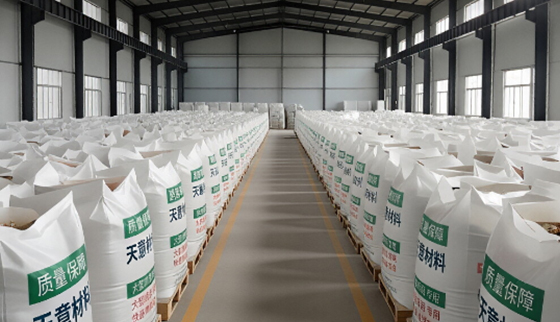
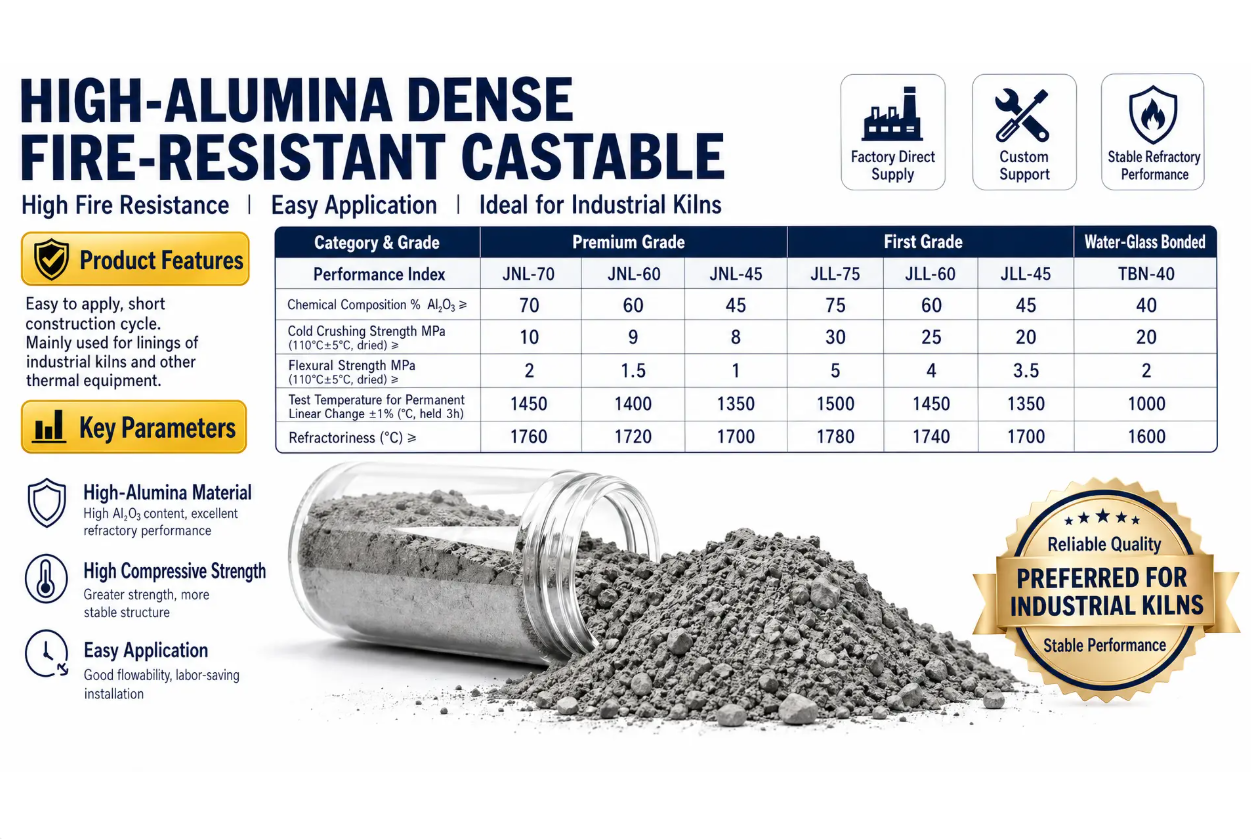
High-alumina castable is an unshaped refractory material made primarily from calcined high-alumina bauxite as the main aggregate, combined with refractory fines, binders, and functional additives. Depending on the product grade, its Al₂O₃ content typically ranges from 55% to 80% or even higher. It offers excellent resistance to high temperatures, abrasion, thermal shock, and chemical attack.
High-alumina castables can use ordinary cement, low-cement, or ultra-low-cement binding systems according to different industrial equipment and operating conditions. Optimized particle-size distribution and micro-powder technology are used to improve density, high-temperature strength, and resistance to chemical attack.
The product is easy to install. After adding water and mixing, it can be applied by casting, vibration, or pumping, forming an integrated and seamless lining. It is particularly suitable for industrial furnaces and thermal equipment with complex structures, severe wear, and high requirements for lining integrity.
High-alumina castables are widely used in cement rotary kilns, preheaters, boilers, blast furnaces, steel ladles, reheating furnaces, hot-blast stoves, petrochemical equipment, and other high-temperature industrial furnaces.
1. Main Components of High-Alumina Castable
High-alumina castables generally consist of refractory aggregates, fine powders, binders, and additives. These components work together to determine the material's installation characteristics and high-temperature performance.
1. High-Alumina Bauxite Aggregate
Calcined high-alumina bauxite is one of the main raw materials used in high-alumina castables. After calcination, it has a high Al₂O₃ content and good volume stability, making it an effective structural framework for the castable.
The aggregate can be divided into coarse, medium, and fine particles according to the formulation. Proper particle-size distribution helps reduce internal pores and improve overall density.
2. Refractory Fine Powder
Fine powders are mainly used to fill the gaps between aggregates and improve the microstructure of the material. Common raw materials include high-alumina bauxite fines, refractory clay, and alumina micro-powder.
The proper addition of high-quality micro-powders can improve flowability, density, and high-temperature sintering performance.
3. Binder
Binders provide the initial strength of the castable after installation.
Common binding systems include calcium aluminate cement, low-cement systems, and ultra-fine powder bonding systems. For areas requiring higher high-temperature performance, low-cement or ultra-low-cement technologies can be used to reduce low-melting-point components.
4. Additives
Depending on installation requirements, functional additives such as dispersants, accelerators, and retarders can be added to improve flowability, setting time, workability, and overall performance.
2. Main Properties of High-Alumina Castable
1. Excellent High-Temperature Resistance
High-alumina castables are mainly made from high-alumina bauxite and alumina-based materials. They can maintain good structural stability and mechanical strength under high-temperature conditions, making them suitable for furnace linings and thermal equipment.
2. Excellent Abrasion Resistance
In the cement, metallurgy, and power industries, refractory linings are often exposed to material impact, particle erosion, and mechanical wear.
High-alumina castables offer good abrasion resistance and are suitable for areas with high material flow and severe wear.
3. Good Thermal Shock Resistance
Industrial furnaces experience temperature fluctuations during start-up, shutdown, and changes in operating conditions. High-alumina castables provide good thermal shock resistance, helping reduce the risk of cracking and spalling caused by temperature changes.
4. Good Resistance to Chemical Attack
In cement kilns, metallurgical furnaces, and chemical equipment, refractory linings may be exposed to slags, alkaline substances, and high-temperature gases.
By selecting suitable raw materials and formulations, high-alumina castables can provide improved resistance to chemical and slag attack.
5. High Mechanical Strength
High-alumina castables provide high compressive strength and abrasion resistance, enabling them to withstand mechanical impact, material erosion, and vibration during operation.
6. Excellent Structural Integrity
Compared with traditional refractory brick linings, castables can form a continuous and integrated lining, reducing joints and weak points. They are particularly suitable for complex structures and irregularly shaped equipment.
3. Common Types of High-Alumina Castables
According to different binding systems and operating conditions, high-alumina castables can be divided into several types.
Ordinary High-Alumina Castable
Made primarily from high-alumina bauxite aggregate, it offers balanced overall performance and is suitable for general high-temperature equipment.
Low-Cement High-Alumina Castable
By reducing the cement content and optimizing particle-size distribution, this type provides higher density and improved high-temperature performance. It is suitable for industrial equipment requiring longer service life.
Ultra-Low-Cement High-Alumina Castable
This type further reduces cement content and uses ultra-fine powder bonding technology to enhance performance. It is suitable for high-temperature, high-wear, and highly corrosive environments.
Wear-Resistant High-Alumina Castable
The aggregate composition and formulation are optimized to improve abrasion resistance. It is mainly used in areas exposed to severe material erosion and abrasion.
Corrosion-Resistant High-Alumina Castable
The formulation is adjusted for operating conditions involving alkaline attack, slag attack, and chemical corrosion. It is widely used in the cement, metallurgical, and chemical industries.