Why Industrial Furnace Linings Fail Prematurely: Temperature Is Rarely the Real Cause
Why Industrial Furnace Linings “Fail Too Early”: The Real Cause Is Often Not Temperature
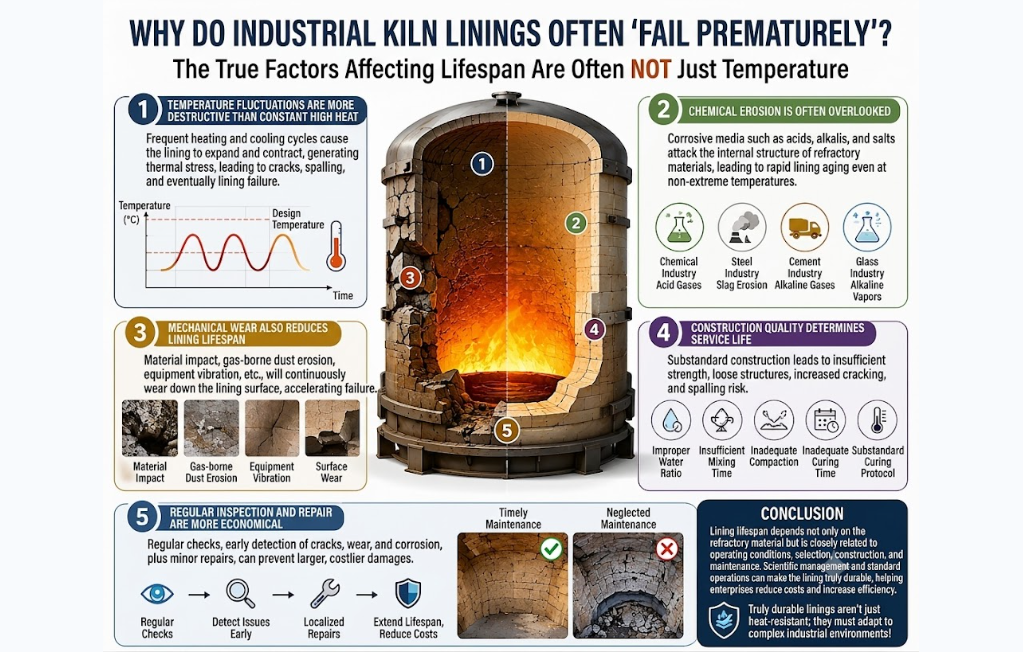
In many industrial operations, refractory lining damage is often assumed to be an inevitable result of high temperatures. However, in real production environments, most premature failures are not caused solely by excessive heat. Instead, they result from a combination of multiple factors. Understanding these key mechanisms and applying targeted maintenance strategies can significantly extend lining service life, reduce maintenance costs, and improve overall equipment efficiency.
1. Temperature Fluctuation Is More Destructive Than High Temperature
Refractory materials are generally designed to withstand continuous high operating temperatures within a specified range. However, frequent start-ups, shutdowns, or rapid temperature changes cause repeated thermal expansion and contraction.
This generates thermal stress inside the lining structure. When the stress exceeds the material’s tolerance, cracks begin to form, eventually leading to spalling or even large-scale structural failure.
Therefore, controlling heating and cooling rates and maintaining stable operation is often more important than simply improving high-temperature resistance.
2. Chemical Attack Is Often Overlooked
Different industries produce different corrosive media during operation, such as:
Slag corrosion in the steel industry
Alkaline gases in cement production
Alkali vapors in glass furnaces
Acidic gases in chemical processing
Corrosive flue gases in waste incineration
These chemical agents gradually penetrate and destroy the internal structure of refractory materials. Even at relatively moderate temperatures, severe lining degradation can still occur.
For this reason, material selection should always be based on actual working conditions rather than temperature resistance alone.
3. Mechanical Wear Also Shortens Service Life
Material movement, slag flow, gas-solid erosion, dust-laden airflow, and equipment vibration all continuously wear down the surface of refractory linings.
Once the protective layer becomes thinner, heat and corrosive media can penetrate more easily, accelerating overall failure.
In high-wear areas, more abrasion-resistant refractory materials should be used, and key zones should be inspected regularly.
4. Installation Quality Determines Long-Term Performance
Even the highest-quality refractory materials will fail prematurely if installation is not properly executed. Common issues include:
These factors significantly weaken structural integrity and increase the risk of cracking and detachment. Therefore, proper construction practices are critical to ensuring long service life.
5. Preventive Inspection Is More Cost-Effective Than Emergency Repairs
Many plants only shut down for maintenance after severe damage has already occurred. This leads to higher repair costs and production losses.
In contrast, implementing a regular inspection system allows early detection of cracks, wear, or localized corrosion. Small-scale repairs can then be carried out before problems escalate.
This preventive approach is far more economical and improves operational reliability.
Conclusion
The service life of industrial furnace linings depends not only on the refractory material itself but also on operating conditions, material selection, installation quality, and maintenance practices.
With proper engineering design, correct construction methods, and routine inspection, lining life can be significantly extended while improving equipment stability and reducing total operating costs.
A truly durable furnace lining is not only heat-resistant—but also capable of withstanding complex industrial environments.