During the operation of high-temperature industrial kilns, refractory materials frequently face rapid heating and cooling environments. For example, in steel smelting, cement rotary kilns,
and glass melting furnaces, the start-up and shutdown, combustion fluctuations, or localized temperature changes all generate strong thermal shocks to the refractory materials.
If the material cannot withstand these temperature changes,
it is prone to cracking, spalling, or even complete detachment; this phenomenon is known as "thermal shock damage."
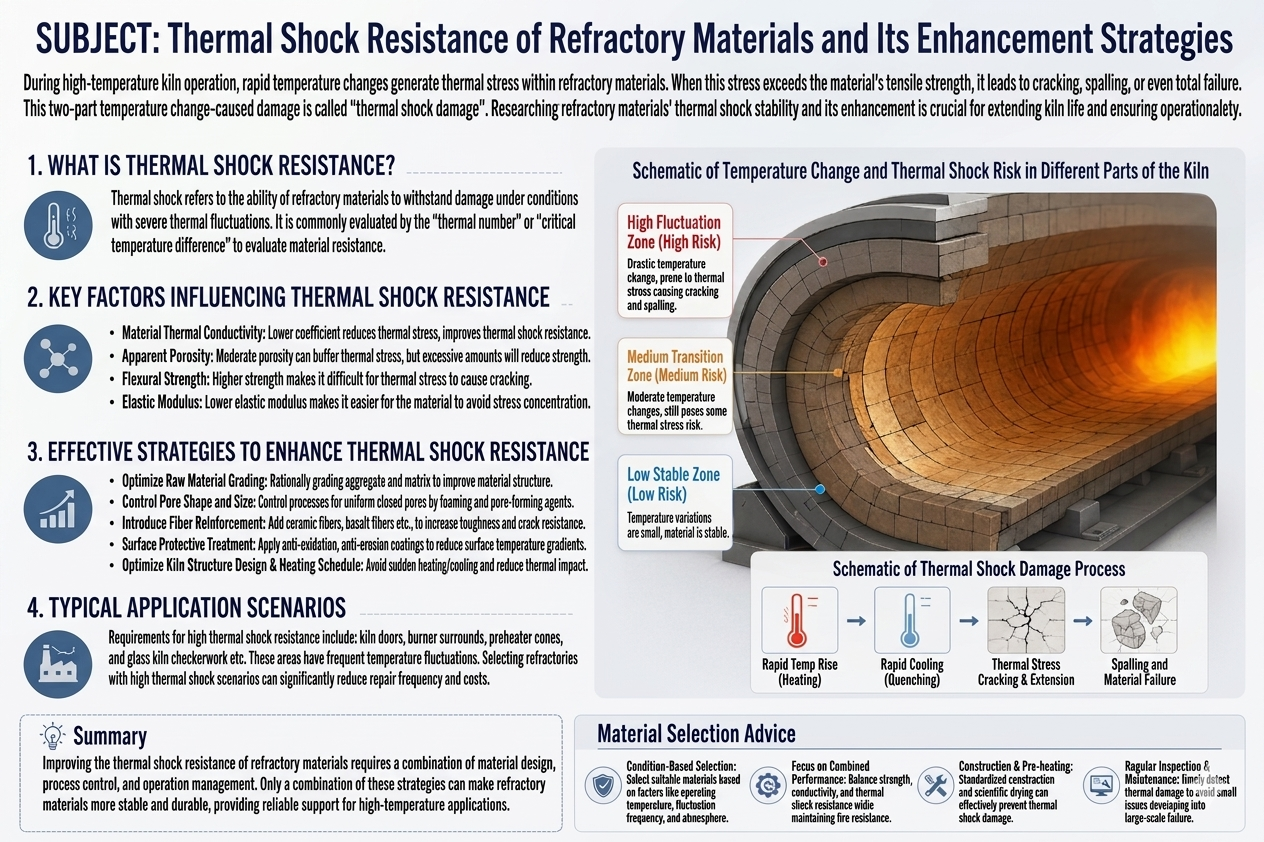
Thermal shock stability, simply put, is the ability of a refractory material to resist drastic temperature changes. The better the thermal shock performance,
the longer the service life of the material in high-temperature environments.
Therefore, thermal shock stability has become one of the important indicators for evaluating the comprehensive performance of refractory materials.
Many factors affect thermal shock stability. First, there is the internal structure of the material, such as apparent porosity, grain structure, and bonding method.
An appropriate porosity structure can alleviate thermal stress concentration,
thereby reducing the risk of cracking. Second, the material's thermal conductivity and elastic modulus are important;
the more uniform the thermal conductivity and the smaller the internal temperature difference,
the better the material's stability. In addition, the material's flexural strength and crack resistance also directly affect its performance in thermal cycling.
To improve the thermal shock resistance of refractory materials,
the industry typically employs various optimization methods. For example, adding heat-resistant fibers to castables enhances material toughness;
optimizing particle size distribution reduces internal stress concentration;
or using composite structural designs creates a more stable thermal balance between the working layer and the insulation layer. Some new mullite materials, low-cement castables,
and nano-modified refractories also exhibit superior thermal shock resistance.
Besides the material itself, construction and furnace drying processes are equally important. If the heating rate is too rapid, internal moisture cannot be expelled in time, easily leading to cracks.
Therefore, standardized construction, proper furnace drying, and regular maintenance are crucial for extending the lifespan of refractory materials.
As high-temperature industries move towards energy conservation and high efficiency, refractory materials not only need high refractoriness but also excellent thermal shock resistance.
In the future, high-performance, long-life, and thermally shock-resistant new refractory materials will play an even more important role in the industrial kiln field.