Application and Development Trends of Lightweight Refractory Materials in High-Temperature Industrial Energy Conservation
In high-temperature industries such as steel, metallurgy, cement, and glass,
energy consumption has always been a key factor in cost control for enterprises.
With increasingly stringent requirements for energy conservation and emission reduction,
lightweight refractory materials are gradually becoming an important direction for optimizing industrial furnace lining systems.
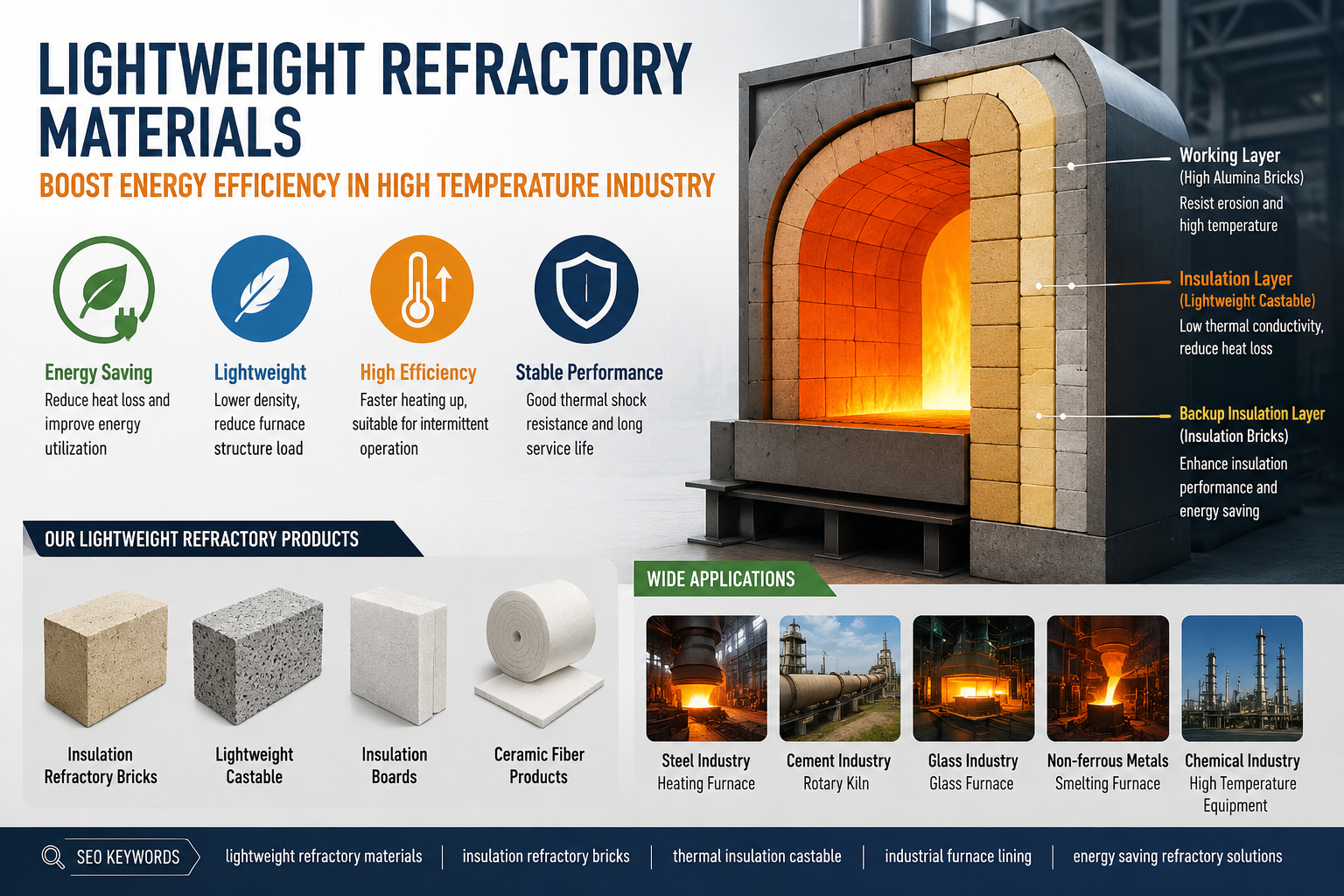
Lightweight refractory materials mainly include lightweight insulating bricks, lightweight castables,
heat insulation boards, and some ceramic fiber products.
Their core characteristics are low bulk density and low thermal conductivity.
Through their internal porous structure design, these materials effectively block heat conduction paths,
thereby reducing heat loss from the furnace body and improving overall thermal efficiency. Therefore,
they are often referred to as an important component of insulation refractory bricks.
In practical industrial applications, lightweight refractory materials typically do not directly withstand severe abrasion or slag erosion.
Instead, they are used as heat insulation layers and combined with high-strength refractory bricks or high-alumina bricks to form composite furnace lining structures.
For example, in high-temperature heating furnaces, the working layer uses high-alumina bricks or corundum bricks,
the insulation layer uses lightweight thermal insulation castable, and the outer layer is further combined with thermal insulation material,
thus achieving the dual effect of "strength + energy saving".
The advantages of lightweight refractory materials are mainly reflected in three aspects: first, significantly reducing heat loss and improving energy utilization efficiency,
corresponding to energy-saving refractory solutions;
second, reducing the overall weight of the furnace body and reducing the load on the steel structure; and third, improving heating efficiency,
making the furnace body more suitable for intermittent operation conditions.
These characteristics have led to their widespread application in steel heat treatment furnaces, cement rotary kilns, glass melting furnaces,
and non-ferrous metal smelting equipment.
Furthermore, with the development of industrial automation and green manufacturing,
enterprises are continuously increasing their requirements for furnace operation stability and energy consumption indicators,
leading to a sustained increase in market demand for lightweight refractory materials. At the same time, material technology is also constantly being upgraded;
for example, new products such as low thermal conductivity nanoporous structures and composite reinforced lightweight castables are being gradually promoted and applied.
Overall, lightweight refractory materials are not only an upgraded alternative to traditional insulation materials,
but also an important technological path for achieving energy conservation and emission reduction in high-temperature industries.
In the future, their applications will become more systematic, combined with intelligent temperature control and energy-saving furnace design,
driving the entire high-temperature industry towards efficiency and low carbon emissions.